

Pitching Camp
by Tom Keer
The entrance to the national forest looked like an ordinary suburban thoroughfare. The roadways on either side of the guard house were wide, freshly paved, and painted with lines indicating a variety of places to turn. A row of strategically placed trash cans sat underneath a series of streetlamps, and if I didn’t know better, then I’d think that the driver of a Porsche 911 would have an awesome time ripping through the nearly 800,000 acres – that’s 1,225 square miles – of land. But the asphalt ended rather quickly, and when it did, it was replaced by smaller dirt and gravel roads used by outdoor enthusiasts and logging trucks alike. Only a 4×4 with good ground clearance would do.
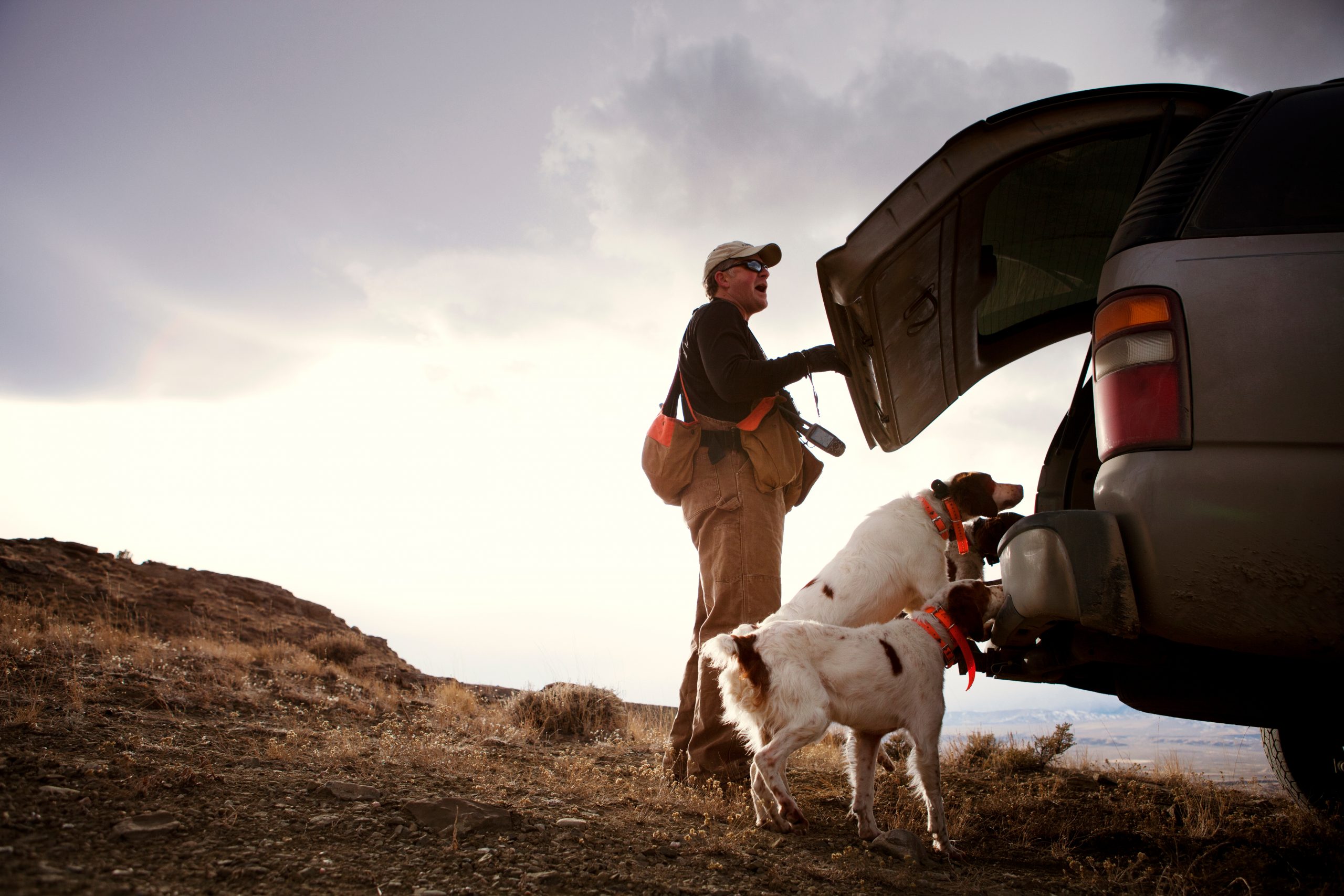
Bird hunting has always been about being in the wild. It wasn’t that long ago when access to the wilderness meant walking out your back door. In many regions, urban sprawl and its associated civility have made that difficult. Easily accessible spots attract competition from other hunters, and that has placed a commodity on finding remote places to hunt. Three hots and a cot aren’t always easy to find in the hinterlands, but if you’re willing to camp, then you can discover good places to hunt without having to drive a long distance to enjoy the comforts of the closest town.
We’re bird doggers first and foremost, so our objective isn’t to pack camping gear best suited for hiking the Appalachian Trail. All we want is a safe place to sleep so we can feed the dogs before sunrise, spend the day chasing birds, enjoy dinner by the campfire, and go to sleep…so we can wake up and do it all again.
Developed campgrounds: A developed campground is one that offers a variety of amenities that make life in the woods easy-breezy. The Bureau of Land Management website is one place to visit for state-by-state venues. Remember this: over 99 percent of BLM-managed lands are open to hunting. That is about 245 million acres of public land located primarily in the Western part of the country. Posh venues that offer shower facilities, bathrooms, tent pads, firepits, and picnic tables are easy to find. Figure out where and when you want to hunt and then drill down with a visit to the state’s website for specific regional information. BLM campgrounds primarily are in Western states such as Alaska, Arizona, California, Colorado, Idaho, Montana, North and South Dakota, Nevada, New Mexico, Oregon, Washington State, Utah, and Wyoming. As you’re gathering information, you can visit a field office in your area of focus.
All is not lost if you live in the Eastern part of the country. While there aren’t many BLM opportunities, there are state campgrounds that provide the same developed campground experience. The website www.recreation.gov offers a state-by-state listing of sites nationwide, and those opportunities are gathered from 14 different agencies. Many list individual campsites, while others have lean-tos, cabins, and electric and water hook-ups for recreation vehicles. Hunting typically isn’t allowed on state-owned properties, but there is a lot in the general vicinity. The is one downside to overnighting in some of the state campgrounds, and that is when they close for the season. Temperatures start to drop after peak leaf peeping ends, typically around Columbus Day. Check closing dates to make sure that you can get in on the best part of the bird season.
Dispersed camping: Fortunately, dispersed camping is another option. Dispersed Camping is pitching a tent pretty much anywhere you want. Set up camp a good ways away from a sign that reads, “Closed to Camping.” Those areas are earmarked to quietly alert campers to dangerous wildlife that is in the area. Dispersed camping requires forward thinking on food, water, and gear, and when you leave, be sure to pack out what you pack in.
If you’re new to remote camping, then know that a relaxing end of a long hunting day starts by selecting the perfect campsite. First, find a level spot of dry ground. Flat ground keeps sleeping bags from sliding off of pads, and it keeps rainwater from a drainage path from gushing into your tent. If it’s windy, set up near a boulder wall or a noll as they’ll help block strong gusts. Setting up under trees can break up rain during a cloudburst, and they’ll offer shade during a hot, bright early season day. Branches and leaves will knock off a few miles per hour during a stiff wind, but look for widowmakers. Widowmakers are dead trees that are still standing or dead branches stuck in other overhead limbs that could fall during a wind.
Other useful gear: A sportscar might not be the best vehicle for accessing national forests and paper company lands, but that doesn’t mean a jacked up 4×4 won’t need to make a 911 call. Off-grid hunting requires self-sufficiency, so here are some must-pack items to keep it safe.
- Two-way radios
- Satellite Communications Device: Garmin inReach is a satellite communications device that offers two-way messaging. The ACR Personal Locator Beacon (PLB) sends distress signals with GPS coordinates.
- A hydraulic jack
- 6 or 10 ply tires reduce punctures from sharp shale and loose rock
- A tow rope
- A come along
- A chainsaw
- A shovel
- A first-aid kit
Camping, especially in remote areas, offers us a chance to find lots of birds that get little – if any – pressure from other hunters. Making sure that you can get back home safely means exactly one thing: You can get ready to do it all over again next week.
Gear
I could hear the wind blow as I drove down the long, sandy road that led to the horseback shooting dog field trial. On both sides were fields full of warm weather grasses rimmed by a mix of pines and oaks. Next to the corral was a line of trucks and trailers parked so meticulously that I figured either this was a dealership or there had to be a cop directing traffic. Some of those trailers were so large that they could accommodate four horses, 12 dogs, all feed and gear, and still have space for a bunk bed, a galley kitchen, a shower, and a head. I had to go to a dealership because it was, in a way, the ultimate in self-sufficient camping.
Before I could even ask about the price difference between the small, compact 18-footer and the large, 45-footer, the salesman looked at my scraggly appearance and said, “I hope you brought your wallet.” I laughed at first, but when he dropped a price range of between $5,000 and $180,000, size and features dependent, I had to think about other less expensive options. Those are the basics that include a tent, a sleeping bag, a mat, some cookware, and a crash pad for a few dogs.
-

- Sea to Summit Detour Stainless Steel One Pot Cook Set
-

- Sea to Summit Pursuit Plus Sleeping Mat
-

- Whiteduck canvas dog bed
-

- Prota Cabin Tent lineup
-

- Whiteduck Outdoors’ Slumbernest
Tent: Every camper needs a home, and the Prota Cabin Tent lineup offers hunters a fast-pitch shelter for truck camps and basecamp setups. But there is no need to live like a monk with a stand-up tent made from weather-resistant DYNATEK™ fabric that can handle strong winds and heavy rains. The durable aluminum frame makes for easy setup and take-down, a built-in awning and premium bug mesh creates air circulation and a bug-proof night’s sleep, and tall ceilings and large windows contribute to stand-up space with good air circulation. A premium bug mesh keeps mosquitoes at bay. A new feature is the integrated stove jack to add heat on a cold day. There are three available. MSRP: $650-$890.
Bag: Whiteduck Outdoors’ Slumbernest is available in 0°, 20°, 30°, and 50°F temperature ratings, which makes it easy to dial in the right level of warmth for different seasons and camp setups. The durable rip-resistant outer shell has a flannel interior made from a soft, high-loft synthetic insulation called CLIMAFILL™. The bag is contoured shaped and can accommodate a pillow. The padded shoulder and neck draft collar retains heat, and the length is suitable for folks up to 6’4”. MSRP: $110-$195.
Mat: Whether you need a mat to preserve warmth or to just add a little comfort, the Sea to Summit Pursuit Plus Sleeping Mat goes from flat to four inches thick with a few lung-fulls of air. The EPEL value makes easy deflation so you can quickly get underway, and a side-loading stuff sack helps maintain order in a truck loaded with gear. The mat comes in a rectangular shape for additional room or a contour shape that is smaller and lighter. MSRP: $159-$209.
Cookware: Some camping hunters pack enough pots and pans that would rival a diner, but if you want to keep things simple, then the Sea to Summit Detour Stainless Steel One Pot Cook Set offers everything you need to feed and water two people. Included is a 3L pot made with a three-ply stainless-steel base that offers even heat distribution on gas or induction camp stoves. The two large bowls and two mugs are constructed in a nesting design that saves storage space. MSRP: $200.95.
Dog bed: If you want to give your gundog room to spread out in your tent, then pack along a Whiteduck canvas dog bed. The inner material is made from a non-woven polyester fiber fill fabric that is four inches tall. The cover is made from 10 ounces of a blended cotton/polyester rip stop fabric with a water repellent coating. The open flat design comes in four sizes, and the cover colors are tan, brown, olive, black, and Realtree Edge. MSRP: $110-$230.