

The Case for Chase
Some trainers, whose end goal is a dog that stands steady to wing and shot, argue, “Why allow a dog to chase today when you’re going to have to break the dog from that habit in the future?” But professional trainer Bryan Camper of Swift Rock Kennel in Walnut, Illinois, who works with dozens of dogs each year, attributes his judicious use of chase as one reason why his dogs have so much style when they go back to their owners.
Camper is in good company with many other trainers who agree that dogs should be allowed to knock and chase birds for a while. Most every pro who goes north to the prairies typically carries a mix of both broke and unbroke dogs each year. The broke dogs are taken to get them in shape for the upcoming hunting or field trial seasons, but the young, unbroke dogs are taken to learn through experience that jumping in on birds is futile because wild birds can’t be caught. It usually starts with an accidental encounter with a bird that evolves into a purposeful search for birds later, where the typical progression begins with immediately jumping in on game, then a short-duration (a.k.a. flash) point. Finally, the dog’s pointing instinct is awakened, and he begins pointing for longer and longer periods.
So what does a trainer do if he doesn’t have convenient access to thousands of acres of prairie with lots of wild birds? He uses good-flying pigeons and electronic launchers to simulate those wild birds. Camper’s puppy program is geared for eight-months-old and older dogs where they all begin with what he refers to as the “popping pigeons portion.” Up to three young dogs run simultaneously from a UTV while homing pigeons are planted in an electronic launcher. This is a purely positive period for the dogs as no pressure is ever applied. Camper says, “Puppies can’t do anything wrong.” Even recall is temporarily ignored during this period, so each dog drags a checkcord to enable Camper to collect the dogs at pick-up time without having to shout or apply any other means of pressure.

Working dogs from UTV, Camper can place a pigeon in a launcher without even getting off the vehicle.
Running three young, untrained dogs together might sound daunting, but dogs are pack animals and tend to stay together. Consequently, they learn quickly to stay in front of the UTV so that they’re not left behind. By essentially pushing the dogs forward via manipulating the speed of the UTV, Camper can place a launcher loaded with one of his homing pigeons in likely cover without even exiting the UTV. He continues pushing the dogs forward for a while before blowing a whistle to signal a change in direction; the dogs quickly learn to turn, catch up with him again, and then start hunting in front of the UTV’s new direction.
He stays close enough to the dogs on this trek back toward the launcher so he can see what they do when they’re close to it. Getting too close to the launcher is cause for launching the bird; they have no chance of catching his homing pigeons that are accustomed to the several-mile flight back to the coop. Recognizing the scent of the bird and then roading in or creeping in to get a better smell will likewise have the same result: The bird is launched and the dog is denied his quarry. All of these launches are done without any verbal corrections or scolding.
Another advantage when chase is allowed is that it’s a great way to introduce gunfire. While the dogs will normally progress to pointing longer and longer, their desire to chase when the bird is launched progresses, too. When Camper sees all the dogs chasing with great drive and at a distance, the blank gun is fired once. Should any of the dogs show a negative reaction to the shot, they’re worked free from gunfire for a while so that subsequent chasing can embolden them more before gunfire is tried again. For the majority of gundogs, however, the distance that the chasing dogs are from the gunfire is slowly decreased until firing can be done while the dogs have just begun their chase and are quite close to Camper and the blank gun.
Within about two weeks of these popping pigeons sessions, the young dogs will point birds for several seconds, and they will typically back another dog that is seen pointing. This is the sign that each dog is now ready for more structured training, and that’s when each dog is run individually from foot. After planting multiple launchers in the bird field, Camper handles each dog via a medium-length checkcord and pinch collar from bird to bird. The pinch collar isn’t necessary for the trainer of just one or two dogs, but it certainly helps when training many dogs – some of which are big and strong – six days per week.
As Camper handles each dog toward the launchers, this is when he begins to introduce the concepts of handling and recall. A light tug on the checkcord as he changes directions means to turn, but this same cue given while he is stationary means to recall. After lots of repetition, verbal cues are added to the physical cues: two short whistle blasts mean turn; and a verbal, “Here” is used for recall. Eventually, the remote training collar is overlaid so that he can enforce changing directions and recall when the checkcord is no longer used. These low-pressure workouts have the benefit of creating a strong bond with Camper, too – he’s viewed favorably because he is the one taking the dog from bird to bird.
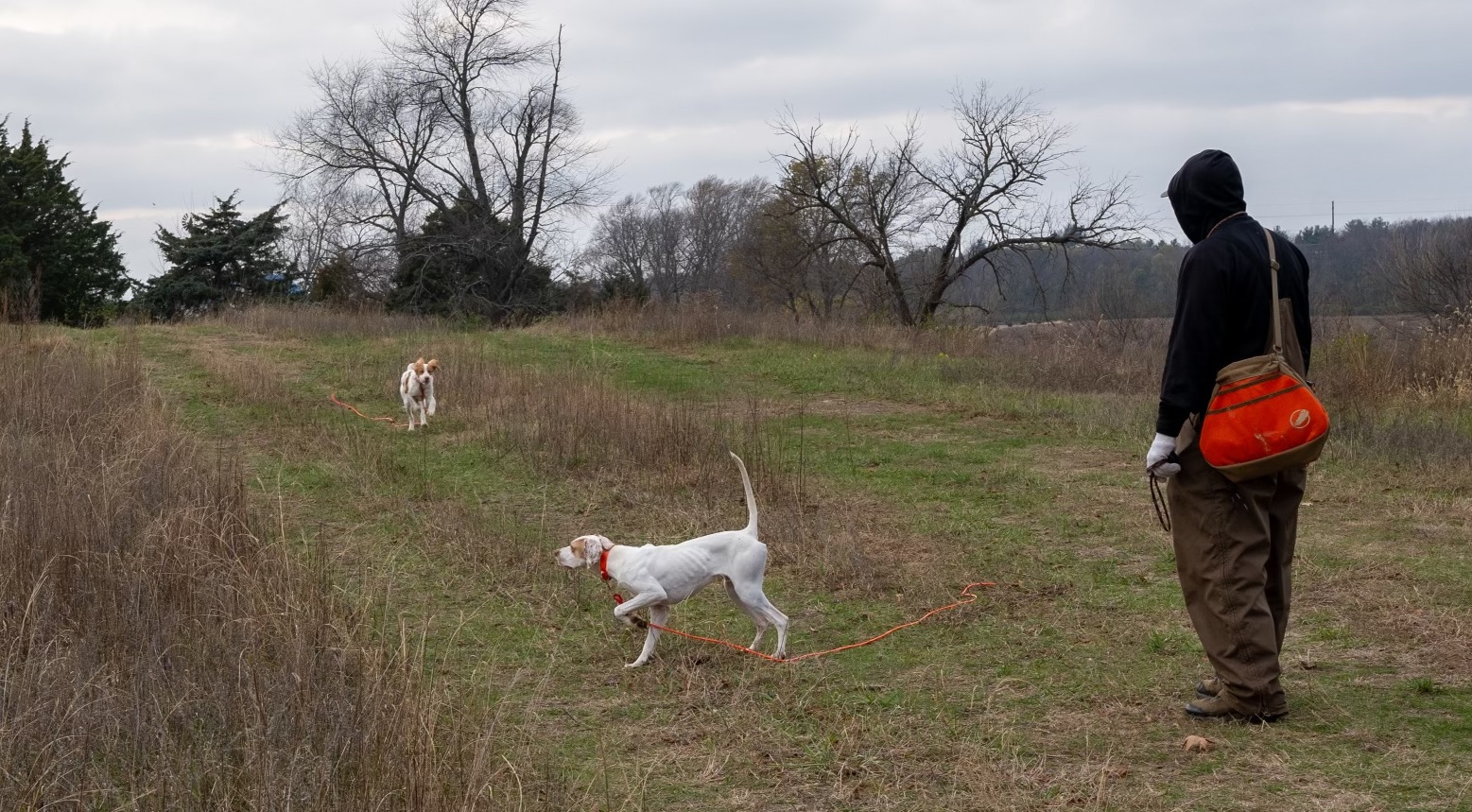
The conditions remain unchanged whether being worked individually from foot or worked as one of several dogs running in front of the UTV: Get too close or try to creep toward the bird, and this results in the bird flying away just as it would in the wild. However, now Camper uses the chase as a reward. If the dog points the bird, Camper allows a brief chase when it’s launched to let the dog have a little fun. Camper doesn’t drop the checkcord for the chase; instead, he maintains control by running 20 feet or so with the dog pulling him somewhat as he runs while holding onto it. If the dog doesn’t point the bird, Camper denies the chase. He doesn’t try to abruptly stop the dog as a form of punishment; he just stops the dog as gently as possible. It’s the forfeiture of the chase that’s used to shape the dog’s behavior toward the desired behavior.
After another couple of weeks, each dog is normally ready for formal whoa breaking. Camper uses the whoa-post method in which the dog is restrained from behind with the whoa post’s checkcord that is attached to the dog via a half-hitch around the dog’s waist and that continues under the dog’s belly and snaps to a regular collar. The dog is also restrained from ahead with another checkcord, also snapped to the regular collar that Camper holds.

The collar on the flank allows Camper to have the instant ability to reinforce the whoa command.
The whoa-post work is the most stressful training that the dog has experienced, so it is performed between bouts of activities that are more fun. The dog might be checkcorded toward a bird or two, then taken to the whoa post for a short but structured workout consisting of just seven or fewer repetitions, and then either back to another bird or perhaps allowed a period of running around while still attached to a checkcord. Just as the remote collar was overlaid to enforce turn and recall, stimulation via a flank collar (a.k.a., belly band) is overlaid during the latter portion of the whoa-post training so that later Camper will have the instant ability to reinforce the whoa command. Note, however, that the dog has been wearing this collar around the flank since graduating from the popping pigeons portion of the program to acclimate to it.
Before returning to hunting for planted birds, the dog runs completely free of the checkcord as low-level stimulation is continuously applied to the flank collar when the dog is commanded to whoa, and the stimulation terminates as soon as the dog complies with the command. The first few repetitions are done without any birds involved to ensure no negative association with the bird and the training collar stimulation. After the dog shows a solid understanding of whoa while running free, Camper again allows or denies the opportunity to chase as dictated by the dog’s actions. Quick compliance to the whoa command results in Camper releasing a bird from a bird bag for the dog to chase; slow compliance does not. The dogs quickly learn to stop as soon as possible, and many of these dogs will even have a pointing posture because the excitement and anticipation of the chase is so great.
From here, the dog finally returns to running free to hunt for planted birds just as he did during the popping pigeons phase, but now, Camper has control of the dog via the flank collar. Chase is once again used as a reward for right behavior or removed as a penalty for wrong behavior. If the dog points and holds while Camper flushes, he’s allowed to chase. Failure to point or pointing momentarily and then jumping in or creeping in on the bird results in an enforced whoa and the planted bird being picked up by Camper with no opportunity for the dog to chase.

For dog training theorists, Camper is using the positive reinforcement and negative punishment portions of B.F. Skinner’s operant conditioning quadrants in his theory of learning. Camper allows chase to reinforce the behaviors of whoaing when commanded or pointing when game is identified by scent. Chasing is not allowed when the dog whoas reluctantly or handles game improperly, and thus, is categorized by Skinner as a negative “punishment,” where punishment just means an action to discourage future bouts of that same behavior.
Since most dogs will be serviceable gundogs for 10 years or more, sacrifice that first season before attempting to steady your dog. You will lose very little time but none of your dog’s style.
Bryan Camper is the owner and operator of Swift Rock Kennels located in Walnut, Illinois. For more than 20 years, he’s been training hunting and competition dogs for NSTRA and American Field trials. More info can be found at www.swiftrockkennel.com and his YouTube channel “Swift Rock Kennel.”
Mark Payton has been training pointing dogs for more than 30 years. He’s the author of the training book Favorite Ways To Train Your Bird Dog and has several training videos on his YouTube channel “Mark Payton Gundogs.”